Friday, December 1, 2023

Rules for walking in the UK. There are none . . . until there are.


Brits love to walk. It is one of the real pleasures of living here, and something we would never trade for a car-centred life. We walk everywhere—errands, visits, the pub—and a decent walk often doubles as exercise and casual community building. Some people take this further and become ramblers, which tells you something in itself.

And yet, while there is a deep affection for walking in the UK, they have far less enthusiasm for walking in an orderly way.

I have spent an unreasonable number of years trying to work out the rules for walking here. I have long suspected that doing so might offer a window into British social life. It might. It is also possible that I am simply a grumpy middle-aged man who struggles to enjoy a walk without becoming annoyed.

One clarification before going further. Queuing and walking are not the same thing. Brits queue impeccably.

Walking—whether on a crowded city pavement or a quiet country path—follows a different and much less obvious logic. This has little to do with how much space there is to walk, or where you are in the country. I have watched two people collide on an empty rural path.

The logic of walking in the UK is cultural. A way of moving through shared space that relies less on explicit rules and more on quiet self-regulation—asking people to work it out for themselves, without making a fuss.

So, what follows is an attempt to see whether that impression holds up—or whether I am simply overthinking a perfectly ordinary walk.


Rule 1: When it comes to walking in the UK, there is no explicit, stable rule… until suddenly there is one.


Most people in the UK move through shared space with little visible concern for collective flow. There is no equivalent of ‘keep left,’ nor a stable expectation that pedestrians will organise themselves in advance. People walk, drift, pause, and change direction as they please, even in places where the layout seems to suggest otherwise.


Until, abruptly, a rule appears.


For people from countries with clearer pedestrian or traffic norms, this is infuriating. Elsewhere, movement assumes a certain kind of attention: you scan for flow, adjust early, and treat motion as a shared coordination problem. When Brits don’t do this, it is easy to read the behaviour as selfish, incompetent, or rude.


But that reading misses the point.


Under Rule 1, people are not expected to manage the system in advance. They are expected to move as they wish, avoid asserting priority, and respond only once a social signal appears. In that context, scanning for flow is unnecessary, pre-emptive coordination looks pushy, and confidently anticipating others’ behaviour can feel intrusive. People appear ‘oblivious’ because nothing yet requires their attention.


Until it does.


The rule becomes visible only through disruption. A look. A tone. A comment. A sudden tightening of the atmosphere. The rule was apparently there all along, but it existed only as an expectation, not an instruction. Its purpose is not to organise movement smoothly, but to correct disruption after the fact. 


This is better read not as dysfunction but as reactive moral governance.


This same logic explains why conflict escalates so quickly when someone explicitly asserts a rule while walking. For example, a pedestrian continues straight ahead on a narrow pavement, expecting others to fall into single file. Or someone holds their line in a crowded station corridor (staying to the left, as indicated by the signs), assuming there is an obvious direction of flow. In both cases, the expectation may be widely shared—but it is not meant to be stated, enforced, or insisted upon.


In those moments, the problem is not simply disagreement about priority. It is that the deeper rule has been violated: do not make the rule explicit; do not force recognition; do not turn tacit negotiation into open confrontation. When that happens, irritation that has been quietly managed suddenly erupts as anger.


To outsiders, this feels perverse. They are trying to prevent friction, reduce risk, and keep things moving efficiently. Brits, by contrast, are trying to avoid overt assertion, avoid policing others, and avoid ‘making a thing of it.’ These goals are fundamentally incompatible.


The result is the same behaviour being read in two very different ways: as polite restraint from the inside, and as staggering obliviousness—or even aggression—from the outside. Rule 1 explains that mismatch.


Rule 2: When a collision occurs, responsibility is managed through repair or deflection—not clarification.


Rule 1 explains how coordination is deferred until disruption. Rule 2 explains why that disruption so rarely leads to improvement.


When people collide while walking—or otherwise negotiating shared space—the moment is not treated as information. There is no pause to recalibrate, no attempt to clarify what should happen next time. Instead, the overriding aim is to contain the disturbance and restore social calm as quickly and quietly as possible.


This is why collisions feel both frequent and unresolved. The system is not designed to learn from disruption. It is designed to absorb it.


In practice, three moves are available.


The first is to ignore the collision even took place. People carry on as if nothing happened, even when it clearly did. No eye contact. No acknowledgement. No recalibration of behaviour. The moment passes, unresolved. This is not rudeness so much as an attempt to prevent the situation from becoming socially real.


The second option is to apologise, often reflexively and sometimes regardless of fault. The British ‘Sorry’ functions less as an admission of responsibility than as a social lubricant. It smooths over the disruption without requiring anyone to explain themselves or renegotiate how the space should be shared. The apology ends the interaction rather than clarifying it.


The third option is to blame the most vulnerable e.g., immigrants, women, people with disabilities, working class. Who is the most vulnerable is situation-dependent, but the entrenched hierarchy (the key phrase here) is familiar. A posh couple may expect a male labourer to step into the road to make space; he, in turn, expects a minority woman to yield on the same pavement.

In these situations, what is striking is what does not happen. People rarely stop to articulate what the rule should have been. There is no collective pause to clarify priority, direction, or right of way. The interaction closes, but the ambiguity remains intact.

In pedestrian systems built around explicit rules, disruption is informative. It reveals a failure of coordination that can be corrected through clearer norms or enforcement. Here, disruption is treated as noise—something to be dampened rather than analysed. Order is restored moment by moment but never consolidated. Social peace is preserved, but at the cost of cumulative learning. 

Rule 3: Do Not Be a Disturber of the Peace


Taken together, these small frictions of walking point to something larger. The patterns described in Rules 1 and 2 are not accidents, and they are not confined to pavements. They reflect a deeper moral orientation in British public life: the overriding cultural commitment to keeping the peace.


This commitment explains why ambiguity is tolerated, why coordination is left implicit, and why disruption is absorbed rather than learned from. Clear rules invite assertion, assertion risks conflict. Better, from this perspective, to allow people to adjust quietly, even if the result is inefficient or mildly chaotic. Social calm is preserved not through explicit coordination, but through restraint.

This logic becomes especially visible when someone makes judgement explicit rather than quietly absorbing the system’s inefficiencies. Recently, I was walking along a narrow pavement where people were repeatedly bunching, stopping, and colliding. After several near-misses, I said somewhat loudly, ‘It might work better if we all keep to one side.’ The effect was immediate and hostile. No one responded to the suggestion. Instead, I was met with tight smiles, sharp looks, and a palpable shift in atmosphere, as if I had committed a social offence.

What was being resisted by my statement was not the substance of the suggestion. It was the act of making explicit what people were already negotiating silently—and what most preferred to keep unspoken in order to avoid disruption. The problem is not whether a rule exists, but whether it is named. Coordination is expected to emerge quietly, through mutual adjustment, not through articulation. Saying the rule out loud alters the social situation by forcing recognition, judgement, and response—precisely the things the tacit system is designed to avoid.

That is not traffic reasoning. It is moral panic about explicit judgement.


What This All Produces: Stability, and Its Costs


Seen at a slightly wider angle, the moral logic visible in everyday walking does not stop at the pavement. The same three rules can be seen operating across major parts of British life. This combination has clear strengths—stability, restraint, and social ease—but it also generates persistent blind spots and entrenched difficulties that are harder to address precisely because they remain unspoken. This is where the rules of walking become analytically useful: they allow both sides of that pattern to be seen at once, not just on the pavement but, more widely, across public life in the UK.


Here are some examples:


On the positive side, one consequence of this moral arrangement is a remarkable capacity for settlement. When big collective decisions land in Britain, society often absorbs them and gets on with the work of living—even when bitter disagreements hold – and without endlessly re-fighting the basic settlement. Brexit is one example. Whatever one thinks of the decision, and despite widespread dissatisfaction and quiet policy recalibration, the vote itself has been treated as settled. Parts of it are being softened, adjusted, or worked around, but the decision has not been directly undone. The country has adapted around it rather than reopening it. 


The same pattern can be seen with same-sex marriage and abortion: once legislated, it became part of the moral landscape, with support now overwhelmingly high. Even the NHS—despite record dissatisfaction with how it is currently run—still commands striking loyalty to its founding principles. Public life benefits from this capacity to settle, adapt, and carry on. It is one of the reasons living here can feel stable, workable, and—at its best—quietly humane.


But the same logic has real costs: once peace is prioritised over clarity, power does not distribute evenly. What emerges is a structural asymmetry. In a culture where most people are socialised to avoid making a fuss, those willing to ignore conventions, push boundaries, or escalate gain leverage. This can be seen in contemporary politics, where movements such as Reform (amongst others) have learned to exploit the fact that provocation and confrontation travel further than restraint in a system slow to push back. It is also visible in long-standing patterns of social hierarchy and elite insulation –remember our point about reversing blame to the most vulnerable? Those with secure status—political, institutional, cultural —act with an easy presumption of entitlement, taking space, bending rules, and reacting with indignation when challenged, confident that others will step aside rather than disrupt the peace.


In turn, the burden of accommodation, meanwhile, falls disproportionately on those with the least capacity to escalate: women, disabled people, ethnic minorities, and others already navigating vulnerability in public space. They adjust, apologise, reroute, or stay silent not because they agree, but because restraint is the safer option. And, over time, the system bends around those least invested in peace. The North–South divide offers a clear illustration: the North is repeatedly expected to absorb economic shock, austerity, and policy retreat, while investment decisions favour the South through opaque adjustment rather than explicit prioritisation, leaving those most affected to adapt quietly rather than contest the terms.


CONCLUSION

It seems we may have wandered a bit from our walk. So let’s return to it. What walking in the UK offers, in the end, is not a theory of British society but a rehearsal space. It is a small, repeatable situation in which strangers briefly share space, negotiate movement, and part again without ceremony. The stakes are low, the encounters fleeting, and the consequences minimal—which is precisely why the patterns are easier to see, if you are paying attention.


There is a Jungian intuition hovering behind all of this: that the points where irritations arise are rarely incidental. They are often where unconscious expectations collide with a system that does not quite organise itself the way you assumed it would. Frustration, in that sense, is diagnostic.


Seen this way, the awkward moments of walking—the hesitations, collisions, and forced reroutings—are not failures but clues. Almost Derridean ones: small disturbances that mark constitutive tensions in the system itself, tensions that are necessary to how it functions but never fully resolved. The pavement does not explain the culture, but it does let you feel, quite literally, where it rubs.


Sunday, July 3, 2022

Taking the Ferry to Buy Bikes in the Netherlands

Reprising the role of travel agent!

Hello all,

Let's just say it has been a while since last I posted. During this time my family and I moved to the UK, where I took a job at Durham University -- which, if some of you recall, was the reason I started this blog, as I came to Durham in 2012 on Sabbatical. Well, I guess we liked the place. As of August 2022, I will have finished my fourth year here. I also recently passed the Life in the UK test and sucessfully applied for Settlement, or what is more technically called Indefinite Leave to Remain! So, I can basically live here. Next year (after twelve months of settling) I can apply for citizenship. For those of you who are in love with "all things UK", you should give a practice test a go. My British friends have enjoyed seeing how well they can do. I am great at the history but terrible on sport.

No sooner did we move to the UK when the pandemic hit and travel was postponed for a rather long time. The pandemic is still here, and we are still vigilant -- wearing our masks, staying out of crowded indoor restaurants and crowded spaces and places, regularly testing, and trying to do our small part to protect those who are vulnerable or putting themselves out there everyday to keep our world running! Much thanks to you all!!!! We support our local restaurants (or when traveling) by getting take-away and eating in outdoor spaces, even when it is 4 or 5 Celsius/40-45 Fahrenheit.  

Inevitably, however, our worlds have begun moving again, and travel is a part of that. So, with a rather significant degree of nervousness, we started traveling and found out that, yes indeed, you can travel rather safely if smart, and you can reduce risk, do the work you traveled to do, and still have a lot of fun.

Case in point, taking the ferry to buy bikes in the Netherlands.


How to buy Dutch bikes and get them to the UK -- Oh, and do so in 36 hours!

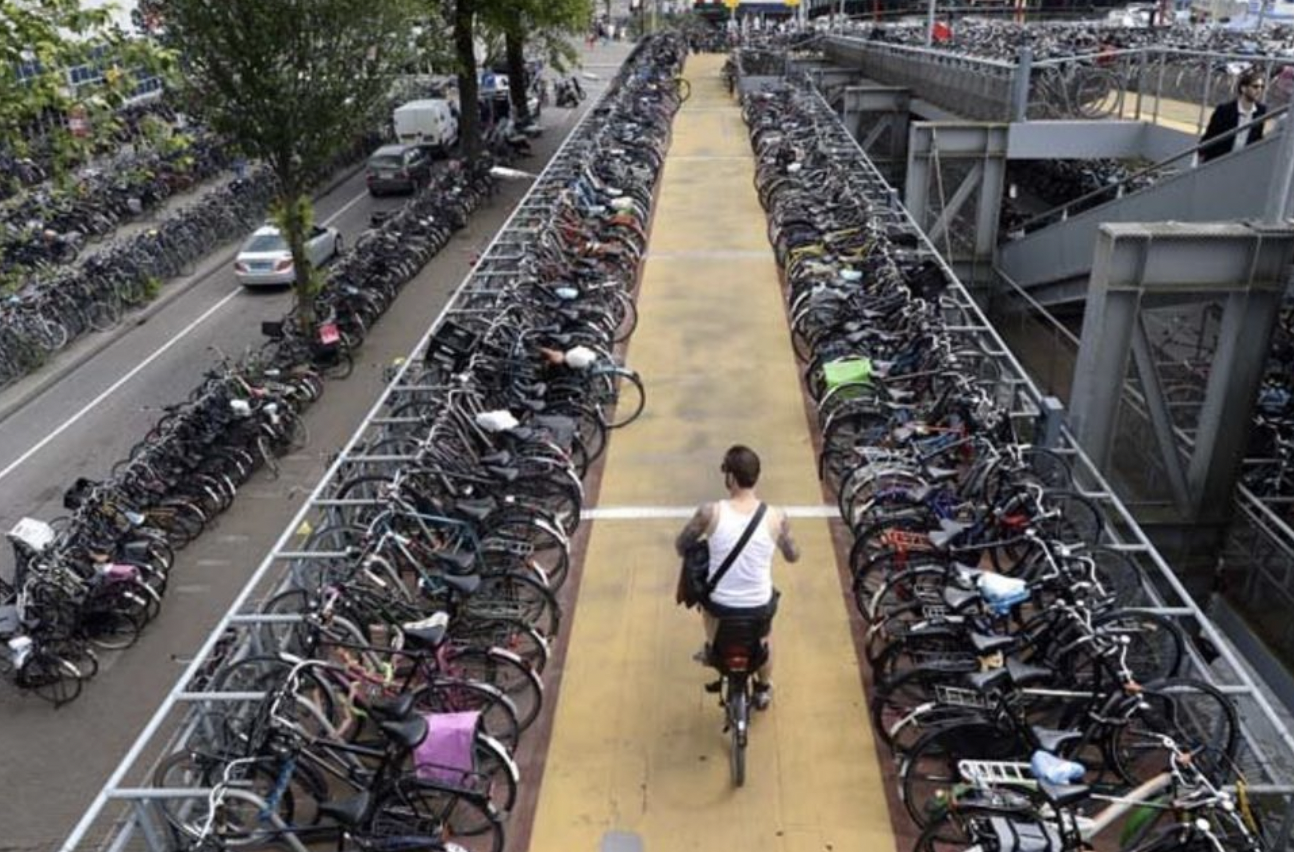
Maggie (my wife), Ruby (my daugther) and I do not own cars. We either walk or use public transportation, which is one of the top five reasons we moved to Europe. There are those days, however, when having a bike would be nice, particularly a nice City Bike, on the back of which we can put groceries and various other purchases. We have had our eyes on a Gazelle City Bike, the crème de la crème, the volvo of city bikes.


With such credentials comes a high price tag! In the UK we are talking about new bikes starting at £1.5k to £2k, and even used bikes being over £700, if you wanted something higher-end. There is a land, however, where bikes outnumber people, and where living on a bike is similar to growing up in car country. The Netherlands!

Rotterdam Central

I spend a lot of time in the Netherlands as a function of the work I do with colleagues at the Institute of Advanced Study, University of Amsterdam, and because of a book I am writing with one of my best friends and colleagues, Lasse Gerrits, who is at the Erasmus University, Rotterdam.


Do not get me wrong, Amsterdam is beautiful. It is one of my favourite cities. Its history is just as rich. The massive impact the Dutch have had on the world does not get the attention it deserves. I highly recommend Amsterdam by Russell Shorto. Absolutely brilliant! The IAS gave me a copy as a parting gift for one of my chats and I could not put it down.

Still, I love Rotterdam.


Rotterdam reminds me a lot of Cleveland, Ohio, in the States, where I lived for 30 years. Rotterdam is a working-class city that had to rebuild itself. Unlike Cleveland, it took post-industrialism, global warming, and the collapsing environment seriously, and transformed itself into a green place. When folks say to me, "Oh, well, sure, of course they do that in the Netherlands; but it is not possible here." I respond back, "That is not true, it is all about making hard decisions." For an overview, here is a BBC article.

Case in point: bikes!

The Deal

Two weeks ago I traveled to the IAS and then Rotterdam for work. I told Lasse that Maggie and I wanted to buy used bikes while there. 

"What?," he said. "Why would you do that?" 

"Because, this is the capital of bikes and used bikes here are like used cars in the States . . . they are everywhere. So you can get something high-end for cheap as it is not as precious."

"Makes sense. . .  but how are you going to get them home?"

This may sound slightly mad, but I thought: I can buy two used bikes in the Netherlands and transport them to the UK and still spend less money then if I bought them new or used in the UK. Prior to traveling to Rotterdam, Maggie and I found a number of really excellent websites that, for a rather small fee, would box and transport your bike from Rotterdam to York, where we live in the UK. The problem was that you needed one day of stting around at a hotel or flat for them to deliver the box. Another day doing the same for them to be picked up. Plus a day to actually see some shops and buy the bikes. I did not have that kind of time. Maggie and I decided to give up on the idea. Perhaps we could just go to Rotterdam and look at the bikes and get inspired. 

So, on our lunch break from work, Lasse took us bicycle sightseeing. He took us to this brilliant shop near the University, called 010 Bikes. It was a blast. 

Then we did what we said we absolutely would not do. We bought two used upscale Gazelle bikes -- one for Maggie and one for me -- for a grand total of £430. A dream of a lifetime! We test rode them, Lasse rode them as well and gave us a "thumbs up"; the shop gave the bikes a quick once-over; we paid for the bikes; and rode them back to campus.

"So," Lasse asked again, "How are you getting them home?"

A long painful pause of silence. . . .

"I've not figured that out yet."

Another rather long moment of pause. . . 

Maggie said, "You know Brian, if there is a will there is a way."

After storing our bikes at Lasse's place, we went to lunch with another colleague and friend, Sophia, to chat about all-thing qualitative complexity methods and social science. At lunch I brought up the bikes. We went round and round about how to get the bikes home. Trains? Post? Finally, Sophia said, "Have you considered taking the ferry? Lasse agreed.

"The ferry?" For real?


Taking the Ferry

A little known mode of travel to us newly arrived immigrants in the UK -- which our European friends knew about and have taken -- was the ferry. The best way to cross the channel, they say! I have never been on a ferry, let alone a sea-worthy boat. This was all new territory. On the last day of our trip to Rotterdam, at the airport, with five hours of waiting on our hands, Maggie and I started looking at ferries. 

The ecological imprint of flying is an aspect of my work I am burdended by. Trains are a great alternative, but the Eurostar presently does not allow you to transport bikes. I needed to do this trip the following week, and I needed to do it quick and cheap, and in less than 36 hours!

That is when we found P&O Ferries.

Given it was recently Father's Day and I was looking for something fun to do with Ruby, we decided she and I would go the following week. We put together our plan.

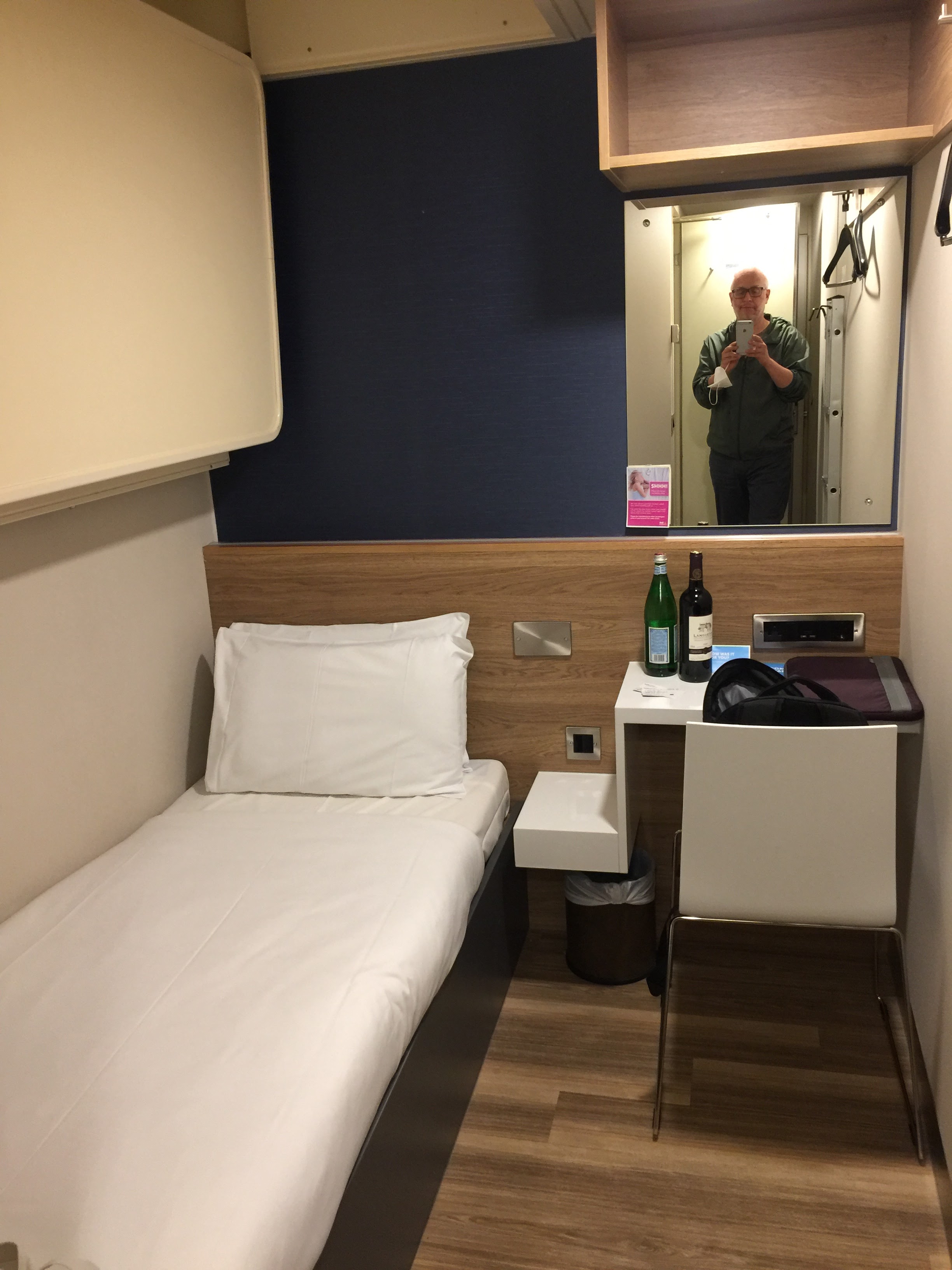
One of the main ferry crossings from the UK to the Netherlands is from Hull (an hour from where we live in York) to Rotterdam. The Ferry leaves Hull almost every day at 8:30PM. So, a week later, on a Monday evening we headed out. We took the train from York to Hull, picked up some groceries, and got to the port. You check-in a minimum of 90 minutes beforehand, you get a standard bunk (see below), they have cheap entertainment, coffee shops, duty free, restaurants, and a few places to walk about. You have dinner, drink a bottle of wine, and go to bed. You get up the next morning, reasonably rested, no jetlag, eat a full English breakfast in the dining hall, grab your stuff, go through passports, and then catch a shuttle to Rotterdam. 

Easy peasy, right? It was a total hoot! The Ferry was full of pensioners, truck drivers, and motor bike enthusiasts. Short of a few families, everyone was 50 years or older. The first leg of the trip was brilliant! 

Well almost! Sea sickness, it is a real thing. There were times when I thought my head was going one way and the ship the other. The key seems to be to forget about it and get on with it. Stay Calm and Carry On.

Arriving at Lasse's place, we went to lunch, chatted about work a bit, and then got the bikes. It was 1PM. We were 17 hours into the trip. We had the bikes and were ready to go. 

Here, however, was the first of several problems we had to solve. Public transportation does not go to the Rotterdam P&O Port and a taxi would run around €110 or more. But, being it is the Netherlands, there are bike paths all the way there, including going over massive motorway bridges!


Lasse printed out the map. It said 27 kilometers. I have not ridden a bike that far in decades. But we do regularly walk 5 miles a day and Ruby not only walks that much but also bikes to work. I figured, okay, it is a bit much but it is a flat ride, paths exist along the way, and I will be tired, but we will be okay. Plus Lasse said we could do it, giving us the confidence we needed. . . "That is," he said, "As long as you don't get a flat tire or something."

And so we set off. 

Fififteen minutes into the ride I got a flat tire! Urgggggggh! Time was ticking, we had a lot of miles to make up and we were stopped flat. What to do? Try to get air and keep riding? Nope. It immediately went flat again. We went to the first bike place. They could fix it but not until the next day. Sorry, that is not going to work.

We decided to go back to the shop where we bought the bikes. A two mile walk back. They would fix the bike on the spot! Awesome guys! A nail the size of a pin had punctured the tire. What luck! 

We waited for them to fix the bike, found an ATM machine to pay in cash (VISA does not work often in the Netherlands) and made our way back to the route to start all over again. 

We had lost an hour and a half. It was now 3PM. I also forgot to mention that it was about 23 Celsius/74 Fahrenheit and, despite Google Maps in hand, we really had no idea where we were going. Backpacks on our bike racks, we once again set out on our route.

After about two hours of traveling, we seemed to be getting nowhere. We were dehydrated and starting to become sun burnt. Ruby asked, "How far are we?" I looked at the map. How could we have only gone only three miles in two hours? We still had 18 miles to go. What was happening? 

That is when we realised I had read the map wrong. Fu*K!!!! The map said 41 kilometers, not 27 kilometers! That is 25 miles, not 17. How are we going to do this? Panic set in. "Time to dig deep and ride," Rudy said, "We need to pick up the pace." 

The second problem was that Google Map does not provide bike routes. Instead, it kept giving us ways to walk there, including taking a few stairwells -- a major statement on where we are regarding travel. So we had to stay fully alert and adjust for errors, which we made. All-in-all, it was 18 miles of mental and physical courage. But also pure joy! I know it sounds cliché, but it was one of those bucket-list experiences. Ruby and I had such a wonderful time!


Through the Dutch suburbs we rode -- which are absolutely gorgeous, by the way! -- then onward into the port district, with massive factories all around and nothing but motorways on either side of us. It was surreal. We even had to pause while this massive lift bridge on the major motorway lifted to let a ship pass. Believe it or not, but the bridge had a two-way bike lane! Two bridge guards stood watch, drinking a cup of coffee and busting our chops as they could see we were novices. But, they did laughingly acknowledge our focus. We were going to make it!

Four hours later, around 7PM, we could see light at the end of the tunnel. More correctly, we could see the Ferry! It was still three miles away, but there it was, in plain sight. Peddle, peddle, peddle, knees hurting, sweating everywhere, hungry, tired, and . . . if I am honest, . .  a bit of chaffing!

Finally, we arrived at P&O Ferry, amongst cars and truckers, gas fumes and all, with little time to spare. We checked in our bikes. Exhausted, we each ate an entire pizza in the pub, drank our wine, watched a movie, crashed, woke the next day, ate our full English, got on our bikes, rode them three miles to the Hull station in the rain, secured them on the train, rode to York, met Maggie, and then walked them to our flat. All in less than 36 hours.

Bikes (£430 total) + Ferry tickets (£430 total) + food etc (£40) + UK train (£30) = 860£k. What a trip!


Sunday, June 25, 2017

Travling to Kosice Slovakia


My brother, Warren, and I are headed to Hungary, Slovakia and The Czech Republic this year to explore further our ancestry -- my mother's parents are from the area (Ocenas), as are my father-in-law's (Rusnak).  Our two cousins, Joyce and Lynn, have been through the area, including Poland, back in the late 1990s and helped us with lots of information about where we might travel -- mainly to learn more about the world in which our grandparents lived prior to immigrating to the States.

I've been to Budapest before and traveled, by train, through Slovakia to Prague, with my other brother, John, en route to a world health conference in Vienna.  We decided to go to Budapest because it is the home city of one of my friends, a fellow complexity science colleague.  We loved it there, happening to arrive on St. Stephen's DayFor more on my trip with John, CLICK HERE.
  
This time, however, Warren and I plan to travel from Budapest to Prague via a different route.  One destination, which we may well take, is to Kosice -- the largest city in eastern Slovakia.  We are not sure, but my cousins remember the city in stories told by our grandparents.  It is unsettling how fast the past of our immigrant grandparents becomes lost (including the language), within only a generation or two -- a typical story-line for those in the States and elsewhere.  The joy, however, is found in the real experience of traveling back to these places, if only to catch the slightest glimpse of our larger family history, no longer active in memory, but perhaps as a lived dream, as we stand there, in such a town as Kosice, wondering....  

With that said, my brother, Warren, came across this excellent blog post of a similar journey to explore one's family past: 2 Days in Kosice, Slovakia.


Wednesday, October 14, 2015

EVERYTHING COMES WITH CHIPS! Another Fun Blog on the Joys of the UK


Knowing that I am always looking for first-person summaries of travel abroad, a friend of mine -- a Brit living in the States -- just sent me along the following post, which seems to have gone viral.  It is a set of one-liner observations made by an American, Scott Waters, who has made several trips to the UK.

Overall, it is not bad and, I must admit, many of his observations resonate with mine, and it made me glad that I leave for the UK again in a couple weeks, for my tenth trip to this wonderful country!

CLICK HERE TO READ HIS BLOG 


Monday, August 3, 2015

Motherhood Around the World


My wife recently came across this blog -- Motherhood Around the World, which is run by Joanna Goddard and her excellent Cup of Jo blog -- and sent it to me.  It is really interesting, as it explores, from a first-person perspective, the oft unique and also common challenges women face raising children around the world.  I find particularly interesting the posts where someone has moved to a different country and are raising kids in a place culturally foreign to their originally known way of life.

To go to the website, click here!